Friday, April 12, 2013

doctors-to-be--->how to start housemanship?

1) register in MMC. For the requirements, pls refer the website. If you havent gt ur certificate (which will be taken during oath taking ceremony), don't worry, u can still register MMC first.

2) Fill up spa form online. Then make a call to spa, telling them that u wanna make an appointment for the interview.

3) Send borang maklumat diri to KKM. Download the form from internet. Before you fill up ur choices for posting, u can (i m not so sure) ask the hospital or JKN whether there is empty posting in that hospital or not......

4) For jpa scholars, don't forget to inform jpa that u have ady finished ur study n u email the form (download from website) to bahagian pembangunan modal dan insan. Claim ur airticket (back to msia), angkat sumpah fees and allowance (once only).

5) Spa interview. For the interview, some ppl may not get medical questions, some may get. So be prepared.

6) Few weeks after the interview, u can make a call to SPA to ask ur result. U will receive SPA offer letter, attached with some forms. U nid to do medical check up as well.

7) Around one month after the interview, u will get KKM letter (with the condition that there are empty postings in the hospital. Currently, there are 7000+ HO in msia...)

8) PTM. For PTM, it is quite relaxing (but if u have rehearsal for the presentation at nite,hmmm...then u may sleep at 12 sth. During PTM, they are highlighting the budaya korporat, nilai2, tell u what are mentioned in Perkara Am BAB A,B,C,D....our career pathway....komunikasi...how to write prescription...etc etc. If u're a lazy and santai person (like me), u don't need to prepare anything. Juz go there and have fun. On the 1st day of PTM, before u sleep, they will give u love letter from kkm, then u will noe where is ur posting. Those who wana appeal, u will write a letter and pass to faci on the next day. On the last day of PTM, for those who appeal, u will get to know the answer.

8) Start working on the following Monday......before that, u nid to call JKN to ask the staff whether u nid to lapor diri at there or straight away go to hosp.

Good luck, doctors-to-be ;) i think as long as we are optimistic and having the spirit, we will get through housemanship eventually and be promoted to UD 44 ;)

Saturday, October 27, 2012

Difference Between men and women


I read a book "why mars and venus collide".i would like to quote some of the points:

1. "most men are not equipped to be the dosmetic/communicative/ romantic partners women fantasize about. Although some men attempt to fulfil that fantasy, in the end both partners become frustrated and disappointed. He may try for years, but eventually he runs out of steam. Some men try during the dating stage and then give up, because they can't continue to meet their partner's expectations. When this is the case, a man may suddenly lose interest and not even know why. He is just not that interested in her, not because she is not right for him, but because he is trying to meet unrealistic expectations."

2. "most women are not not equipped to be the dosmetic/communicative/romantic partners men want. It is unrealistic for a man to expect a woman always to be in good mood, never to be needy, and to be romantically available at all times. Many women try to fulfil this fantasy but feel cheated and betrayed when their partner do not return their love"

So both shall understand and communicate to each other more.

3. "adjusting, adapting, and correcting our expectations can free us from feeling victimized or powerless to get what we need"

4. "it is always a mistake to conclude we are too different to make a relationship work. the truth is, stress can drive a wedge between us. By learning how to support ourselves and our partners at times of greater stress, we can learn how to lower stress levels. When stress is removed from the formula, our differences are never a problem. When stress is reduced, our differences are a major source of fulfillment,"

5. "the problem is never just our partner, but our own inability to cope with stress. When we learn how we can deal with stress more effectively and help our partners cope, the grip of our unrealistic demands is easily released. We are then able to enjoy the feelings of acceptance, trust and appreciation."

6. "when a man becomes more like a woman in a relationship, he will inevitably become overwhelmed, exhausted, and stresed. However, men need to be sensitive to the needs of women"

7. "a woman can learn ways to lower her partner's stress by helping him feel successful in helping her. Though a man does appreciate domestic support, positive communication and romance, what is most important to him is to feel he is providing his partner with some measure of fulfilment. Instead of thinking of direct ways to support him, she can actually could do less, and  simply appreciate what he does for her. This works well, because women are already doing way too much. Wouldn't it be great if a woman could do less and a man would feel more supported? it is true."

8. "When a man takes action to support a woman's needs, she feels supported".

9. "Even when a woman takes time for herself, she can help a man feel like a success in a relationship. When she is happy he will always take credit and feel better. Without this insight, a woman would never think that taking time for herself could actually help her partner. When men take time for themselves, women often feel neglected. For this reason a woman might find it hard to believe that taking time for herself actually supports him in giving more to her. Understanding our differences provides a completely new direction for men and women that not only brings out the best in our partners but makes relationships so much easier"

10. " When she thinks she needs a more sensitive man, what she really needs is to express her more vulnerable self. What she really needs is to be heard"

11. "when a man needs time alone or doesn't want to talk about his day, it doesn't mean that he cares less for his partner. When a woman wants to talk bout her day, it doesnt mean she is excessively need or high maintenance"

12. "When a man in danger, he needed to stay quiet much of the time. to this day, faced with stress, a man will often become quiet. A a result, men go to their cave to recover from stress, while women have adapted by learning to talk bout their stresses. By letting others know about her problems, she would make it easier to get their support. unless she talked, others simply would not know what she needed"

13. " a woman's brain has a larger corpus callosum, the bundle of nerves that connects the right and left hemispeheres of the brain...In practical terms, this means men do not connect feelings and thoughts as readily as women do. In a very real sense, women have superhighways connecting their feelings to speech, while men have back roads with plenty of stop signs. some researchers believe that the integration of the two lobes maybe the source of "women's intuition"- in other words, whole brain precessing.

14. When she is listening, she is also thinking, remembering, feeling and planning all at the same time.

15. " a man's brain is highly specialized, using a specific part of a single hemisphere to accomplish a task, A woman's brain is more diffuse, using both hemispheres for many tasks. This neurological difference allows men to focus and to block out distractions for long periods of time. On the other hand, women tend to see things in a broader context, from a larger vantage point. Men tend to do one thing at a time in their brains and in life. When a man is under stress, he can easily forget his partner and her needs. A woman can easily misinterpret his forgetful behavior as uncaring"

16. " A man can more easily disengage from his serious, responsible left brain and allow it to rest and regenerate. When a man is stressed, he can simply change his focus to a hobby or watching tv and he begins to relax. He shifts from using his left brain, which is logical, practical, and reality-based, to his right brain, which is feeling, risk-taking, and fantasy based. By making this shift, he automatically disconnects from the stress of his responsibilities. A woman does not have this luxury..A woman's brain is busy connecting everything. The more she cares about something, the more she connects it to other things going on in her brain"

17. "women's brain are wired to feel and recall emotions more intensely than the brains of men. The process of experiencing emotion and coding that experience into memory is more tightly integrated in a woman's brain and her neural responses are more tightly integrated. though scientists have not yet been able to identify the neural basis for the difference, studies have found that women tend to have more vivid and stronger memories of emotional events than men. Compared to men, women can recall more memories more quickly. Their memories are richer and more intense. When under stress, a woman's mind can become flooded with these memories."

18. "..woman can easily adjust her expectations. She is not lowering her expectations, she is simply adjusting them to what is realistic"

19. "A man will ask for help, but only after he feels he has done everything he can on his own"

20. "on venus, every gift of love scores equal to every other gift of love, no matter how big or small"

21. "To score more points, rather than bring a dozen roses and get two points, a man can bring one rose twelve times and make twenty-four points" :))))

22. "four hugs a day is an easy way to score lots of points with a woman"

23. " Just by talking about all the things she has to do, she begins to release the inner compulsion that commands her to do more and not take time for herself."

24. " men's need for space to be alone, and women's need for more time to be together. When man's need to be alone, i labeled it as "cave time". A man needs his cave time to replenish his testosterone levels, which are low at the end of the day. just as women, need more time to talk share, and cooperate with a man, a man needs more time to recover from his stresses by having plenty of space to do things on his own, or at least to be in control of what he does. Men need thirty times more testosterone to cope effectively with stress.while taking a break, women can also use alone time to take a breath, to nurture herself. But this is not easy to do. For some women, just the thought of taking time can be overwhelming. They imagine what would happen around them...Just as women recovering from stress have difficulty taking time for themselves, men under stress have difficulty being there for others"

25. "to release some stress, a man tends either to solve the problem or to dismiss it in some way. A woman looks for a warmer, more supportive response.

26. "men shopping with their partners may feel exhausted as if they are wandering in the desert. Unless he comes across a starbucks or a victoria's secret soon, he may die on the spot (me: LOL) Men do shop on therir own, and enjoy it. Men can obsess about cars, electronics, and gadgets. A man needs to have a clear destination or goal. He wants to get in and out as quickly as possible. He is a man on a mission"

27. "when women don't get a chance to talk throughout the day, they become stressed (LOL, but true :p) When a woman returns home, she needs to share her feelings with her partner. 

28. "remember, a man's caapacity for empathy is not nearly as developed as it is in woman. The emotional part of the brain is twice as big as it is in a woman. The emotional part of the brain is twice as big in a woman...His testosterone-oriented nature seeks to solve problems right awy, When he understands that listening can solve her biggest problem, he can easily do it...If we don use it, we lose it As a man practices Venus talk with his partner, he will gradually grow in his ability to feel empathy and compassion"

In the beginning of every relationship, it is always sweet and happy because the differences between man and woman are not revealed yet. When friction happens, or reaching a plateau stage, this means that differences btwn man and woman have surfaced and both of you have not fully understood the basic difference btwn you both. Wish this book can help you to understand the difference btwn man and woman, so that you will know the problem that you find in ur partner is no longer a big problem, it s normal for him/her to have that problem. Then we learn to understand, to communicate and cope the stress.Less stress, less friction~Hope you guys will enjoy reading this.

Thursday, December 30, 2010

should u struggle?or should u not?

*touchwood*

If one day you are smothered by someone n you are still conscious at that moment, u should struggle violently? or you shouldn't do that?

There will be 2 outcomes of struggling:

a) There will be abrasions on the face/nose or contusions of the lips due to the pressure of the palm. Therefore, when your dead body is examined by forensic doctors, he/she can suspect that your death is due to homicidal smothering.

b) You will die faster due to increased utilization of oxygen.

BUT,

if you don't struggle, you will leave no evidence to the forensic doctor. The autopsy will fail to disclose any injuries. He/she cannot find evidence to prove that you are dead due to homicidal smothering.

Conclusion,

If this happen to you, it is better for you to struggle violently :p oh yea, make sure u build up emotion intensively, so there may be cadaveric spasm after u die.

Reference:
1) Dimaio V.J and Dimaio D, 2001. Forensic Pathology 2nd edition. Boca Raton, London. CRC Press.

Thursday, December 9, 2010

I want to tell u story

Hardly remember the name of the drugs against Influenza A?

Let me tell you story about adamantanes and neuraminidase inhibitors.

Once upon a time, there were 2 families: adamantanes and neuraminidase inhibitors. Adamantanes have 2 children: aman (amantadine) and raman (ramantadine).


Assume they are amantadine and ramantadine :p
 One day neuraminidase inhibitors met adamantanes and his 2 children in Pogung Baru.

"Hello Adam. Are they your children? They are very cute!" said neuraminidase inhibitors.

"Yes, they are. I heard that you have married few years ago. So, do you have any children?" asked adamantanes.

"Yea, I have two also. One is named Zana (zanamivir) and another is named as oselta (oseltamivir)," said neuraminidase inhibitors with his lips curved into a smile.

"So, how is your life now? Do you....still contact with Influenza A?" asked adamantanes.

"Yeah, I'm working with him now. He is my boss. As always, he is still as irritating as last time in the class. Do you still remember how he bullied us last time?" said neuraminidase inhibitors.

"Of course I remember! And recently, he had annoyed me very much. He made my ducks and pigs sick by injecting them with virus! I wanna revenge! However, I hardly approach him as he has already known that I wana take him down (drug-resistant). I need someone to help me. Since you hate him so much and he doesn't know this ( less likely to promote drug resistance), you still stand a chance to approach him and to defeat him. How about we have a conspiracy?" said adamantanes.

"Why not? Count me in, dude! We should work this out together!" said neuraminidase inhibitors.


------- The end----------
  
Hopefully this story helps you. This is the way I memorize the drugs and which one will create drug resistant.
Hope you enjoy reading this story.

Reference:
1) Dr. Titik Nuryastuti. Lecture: New Emerging Disease Avian Influenza Coronavirus/SARS.

Wednesday, December 8, 2010

Nosocomial infection: whose fault?

A 60-year-old lady was admitted with the complain of epigastric pain and dyspnea. She was previously admitted for few times with the same complain. The ECG was normal and other examinations were within normal limit. The doc suspected she had peptic ulcer. On the 3rd day of admission, she had fever and back pain. On examination, renal punch on left side was positive. The urinalysis showed that leukocytes +, granulocytes level increased. She was then treated as UTI.

At first, the patient had epigastric pain and dyspnea. The patient was then hospitalised due to the unrelieved pain and dyspnea. On the third day, she suddenly had UTI. Why did the patient suddenly had UTI? What do you think? Nosocomial infection? Do you agree?

There are two types of nosocomial infection:

a) endogenous infection: the causative agents comes from the patient and the infection develop during hospitalization as a result of the patient's decrease of resistance.

b) cross contamination followed by cross infection: the patient comes into contact with new infective agents and develops infection.

Source of nosocomial infection:

a) Human: patients, hospital workers
b) Environment: water, air, waste, food, device (endoscope, ventilator), dust

Factors that contribute to this development of nosocomial infection:

a) The microbial agent
b) Patient suscepbility
c) Environmental factors
d) Bacterial resistance

SO, for nosocomial infection cases, whose fault? Can the patients sue the doctors?

If you look at the source and the factors, you will find that we can actually blame a lot of parties:
a) Blame the patient! why do they become weak? Comon, make ur immune system stronger!

    The patient may say: "errr...why do you blame me? I can't help with this! I've already kept the environment clean and always eat healthy food. But, still, I am infected! And maybe you have to blame the doctors! They are the cause!"

b) Blame the hospital workers:
  • Doctors: Blame them for giving antibiotcs to the patients. Blame them for using devices,like endoscope, when examing the patients. Blame them for asking the nurses giving them IV line, giving injection.....
         But the doctor may say: "If I don't give them antibiotics, the patients will not be cured. We can't solely rely on their natural defense system, ain't? Furthermore, even if I order blood culture, I still need to give them broad spectrum antibiotics while waiting for the lab result. This is not avoidable; If I don't use a device, I can't make an accurate diagnosis! I can't simply make a diagnosis based on anamnesis and physical examination. I need supporting examination; If I don't give them IV infusion, they may suffer hypovolemic shock or hypoglycemia; and How sure are you that I am the cause of nosocomial infection?"..... etc etc
  • Nurses: Blame them for not using antiseptic procedures! Blame them for not washing hands!
Nurses may say: Show me the evidence before you blame me!

  • Hospital cleaners: Blame them for not mopping the floor every hour! Blame them for not empty the bin every hour!
Hospital cleaners may say: Do you think I am a robot?

c) Blame the microorganisms! why do they need to develop a resistant strain? why do they invade the human body?

Therefore,

I don't think doctors should be blamed. The main point is DOCTOR is NOT THE ONLY PARTY responsible for this, but ALL PARTIES. How sure are you that the doctor is the factor or the only factor for causing nosocomial infection? How if it is not the doctors' fault, but the nurse or the patient themselves for being too weak? How if the infection is transmitted through dust, air, food, water, but not from the human? So, forget about it. Stop blaming each other. It s better that we human take actions in preventing this-Do it hand in hand!

What are the prevention?

1) Do a surveillance. Perform antibiotic susceptibility test and monitor the trends in prevalence of bacterial resistance to antimicrobial agent.
2) Based on the surveillance, make a list of antiobiotics in which the doctor can prescribe to the patients.
3) Doctors should prescribe narrow spectrum of antibiotics if possible; When waiting for lab test result, apply empirical treatment/ based on guidelines.
4) Use prophylactic antibiotic only in situation where proved valuable.
5) Sterilization
6) Disinfection, eg fogging.
7) Avoid environmental contamination: Maintain the environmental hygiene and sanitation.
8) Use containment isolation procedures for patient infected with resistant organism.
9) Aseptic hand washing procedures.
10) Safe injection method.
11) Apply crop rotation policy: It is used for predetermined period (e.g. 3 months) and rotated to another antibiotic after 3 Mo and another after 3 Mo and finally recycled.
12) Ensure personal hygiene.
13) Wear gloves, mask, etc.


Let's do these together ;)

Reference:
1) Prof. Dr. Irwan Dwiprahasto. Lecture: Pharmocology: Drugs Formulary and Antibiotic Hospital Policy.
2) Dr. Hera Nirwati. Lecture: Nosocomial Infections.

Sunday, December 5, 2010

Should Dr.Sardjito General Hospital be fined or given a warning letter?

Yesterday, when I was walking into IRNA I of Dr. Sardjito Genaral Hospital, I saw a lot of people (more than 10 ppl) smoking outside IRNA I.


Wow, more than 10 people smoked in the hospital compound!!

For your information, one of the obligations of a hospital is to enforce all hospital environment as non-smoking area. Administrative sanction will be imposed upon those hospitals which refuse to fulfil the obligation. The sanction can be:
  • warning
  • written warning
  • fine and cancellation of hospital permit
So, my question is: Since Dr.Sardjito General Hospital does not fulfil the obligation, should it be fined or given a warning letter?

Reference:
1. MOH. Guest lecture: Hospital Law (Legal Aspect of Hospital)

Friday, December 3, 2010

I'll help you to tell your family who you are

"I'm Dr.O. i'll strain all my nerves to find out your identity...I'll help you to tell your family who you are!"

Whose identity???

A burnt dead human.

wow, this is the job of a forensic anthropologist. They are gotta identify the dead when the victims are with unrecognizable face and bone exposure or the body is mutilated or only part of the body is found.

Scenario:


No. 46-102/40 was unrecognised because the victim was burnt. So, Dr. O, a forensic anthropologist, was asked to identify the victim.

So, what does "46-102/40" means?
It means body number 46 removed from the site at grid co-ordinate 102/83.

If it is "46P-102/40", what does it mean? How about "M46"?
"46P-102/40" means body part number 46 removed from the site at grid co-ordinate 102/40; "M46" means body or part number 46 which was labelled at the mortuary and therefore no co-ordination was written down when labelling.

The forensic anthropologist is gonna identify the race, stature, sex, and age of the victim.

1) Race.
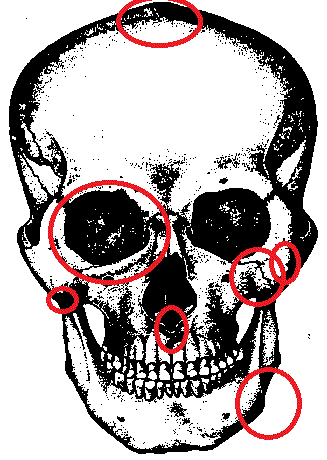
The picture below is the skull of 46-102/40. So can you identify the race of the victim? (I have circled the important characteristic, hope this can lead you to have some idea)


"The skull is keeled and brachicephalic (short but broad skull). The major suture of the skull is complex.The orbits are round and the nasal is slightly depressed. The nasal spine is moderate. The victim has projecting zgmomatics and malar tubercle. Besides that, the zygomaticomaxillary suture is angled. The dentition is edge-to-edge bite and the buccal pits are obeseved. The victim's face has everted gonion angle.Therefore, the victim is identified as mongoloid."

What about the other characteristic of mongoloid? Let's look at the picture below.

How do you know that is not caucasoid or negroid? Let's look at the picture below.


Caucasoid skull
 So the picture above is caucasoid. The important features are:
  • dolicocephalic skull (long but narrow skull)
  • the major suture is simple
  • sloping orbits
  • narrow nasal aperture; tower nasal; deep nasal sill and large nasal spine
  • s-shaped zygomaticomaxillary suture
  • retreating zygomotics
  • the face has straight gonion angle
    Negroid skull
    The picture above is negroid skull. The important features are:
  • the skull with post-bregmatic depression
  • the major suture is simple
  • s-shaped zygomaticomaxillary suture
  • rectangular orbits
  • guttered lower nasal border; wide nasal aperture; no nasal spine
  • large prognathism
2) Stature.

"The humerus length is 31 cm. So, the stature is estimated between 160.16 and 168.66cm"

To estimate the stature, we usually use humerus. But if humerus is not found, other long bones will be used, such as femur. Caliper is used to measure the length of long bone. There are different formula for different long bone. We then substitute the length of the long bone into the formula. After that, calculate it to get the range.

3) Sex
Male pelvis
"The pelvic inlet is small and looks like a heart shape. The subpubic angle is acute (70 degree). The ventral anterior margin of the obturator foramen is sharp. The acetabulum is wide and deep, facing laterally. Besides that, the sciatic notch is angled ,deep and narrow. The ilium is vertical (stand up). The fossa auricularis is long, and narrow, curving anteriorly.There is no parturition pits, nor the preauricular sulcus. By examining the skull, I find that the supraorbital ridge is prominent and is not smooth. The mastoid process is large. So, the victim is identified as a male."

The picture below shows how a female pelvic looks like.


female pelvis
 Further reading: Tortora G.J., Derrickson B. Principles of Anatomy and Physiology. John Wiley & Sons, Inc. 11th edition, 2006. Page 244.

We can also identify sex through secondary sexual signs, e.g. mammae; cranial bone; and sex chromosome.

4) Age.


"By using the dental attrition, the estimated age of the victim is 30-35 years old"

For the burnt dead victims, teeth is important in identification. For the dental atrition, the concept is as one grows older, there will be more enamel loss.

Age estimation by using dental atrition
However, there is factor which influencing the accuracy of using this method. Humans eat a variety of food which promote enamel attrition at different rates. Therefore, this may influence the result of estimating the age.

Besides using dental attrition, dental formation and eruption times is used in estimating age to approximately 15 years. For the old age, can try to identify the changes of bone due to arthritis or osteoporosis and their orbits are lipping.

To estimate age, we can also use pubic symphysis.


Another alternative is we access the bone growth.

 So, 46-102/40 is identified as a mongoloid male, whose stature is between 160 and 169cm, with estimated age 30-35 years old. To find his identity, we need the ante-mortem data and further lab test, e.g. DNA, and then we will do the reconciliation.

Reference:
1) Prof. drg. Etty Indriati. Lecture: The Roles of Anthropology in Disaster Victim Identification.
2) Dr. Yudha Nurhantari. Lecture: Management of Dead Victims in Mass Disaster.
3) http://people.wku.edu/darlene.applegate/forensic/lab9/lab9.html (Identify race)
4) http://www.the-crankshaft.info/2010/07/morphological-age-estimation.html
5) http://www.interpol.int/public/DisasterVictim/guide/chapitre4.asp
6) http://medical-dictionary.thefreedictionary.com/dolicocephalic+skull
7) http://education.yahoo.com/reference/gray/subjects/subject/58 (Female pelvis)
8) http://en.wikipedia.org/wiki/Pelvis
9) http://www.wadsworth.com/anthropology_d/special_features/forensics/forensics_index/index.html  (Role of forensic anthropologist)
10) Tortora G.J., Derrickson B. Principles of Anatomy and Physiology. John Wiley & Sons, Inc. 11th edition, 2006. Page 244.
11) Practical Guide Block 4.2: Forensic Anthropological Identification of Disaster Victims.

Thursday, December 2, 2010

The dead

"A volcano eruption has just happened. A lot of people are dead. We need your help!"

When death is involved in a disaster, we need to identify the dead victims. Why? it is a respect of death person, and it is for the purpose of legal claims and obligation in relation to property, estate and debts.

So, who are in the disaster victim identification (DVI) team?

1) the police or interpol (international police)
2) forensic pathologist, anthropologist and dentist
3) army
4) trained volunteers

There are few procedures in DVI:

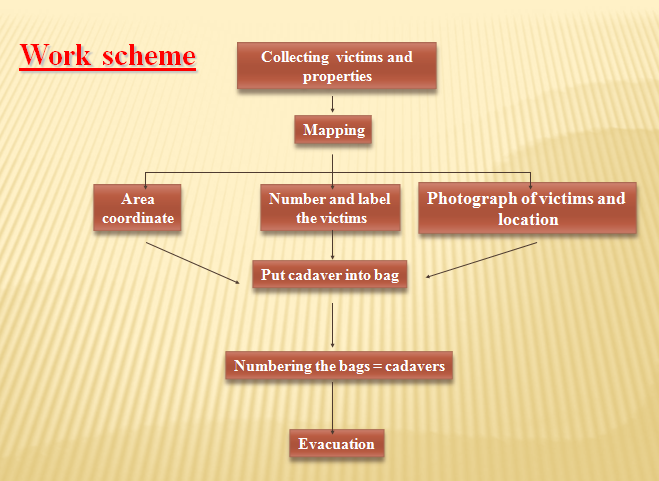
1) Phase I: Scene. The team will search for bodies, body parts, properties, mapping the area of disaster, labelling, documentation, putting the dead bodies in body bags.

2) Phase II: Mortuary: Post-morten examination. They will do:

a) Documentation: bodies, body parts, properties.
b) External-internal examination, autopsy: forensic pathologist's job.
c) Identification of race, sex, age, stature: Forensic antropologist's job.
d) Dental examination: Forensic dentist and anthropologist's job.
e) Record body fragmentations: What body parts are missing.
f) Taking samples for DNA examination: blood, tissue, bone, teeth.
g) Taking roentgen of the upper and lower jaw with teeth.

All post-mortem examination data is recorded in pink form.

3) Phase III: Antemortem data compilation. The data is gathered from family members, friends, doctor, dentist (medical record for matching with the primary identification traits). The data can be vital signs, specific characters, jewelery, watch, clothes (for matching with secondary identification traits). All the antemortem data is recorded in yellow form.

4) Phase IV: Reconciliation. It is to compare antemortem data with postmortem data. Identification is confirmed when there is one primary identification method is matched (DNA, fingerprints, dental profile) or at least 2 secondary identification method are matched ( visual, photography, properties, medic-anthropology).When all parties provide evidence and proofs that matched/identified-->signed and dated.

5) Phase V: Release and debrief.
  • Release. The dead body is released to the family member, along with the letter.
  • Debrief: Compile documents. DVI team is dismissed.


How if the dead body is unidentified?
According to Dr. Yudha Nurhantari, a victim is defined as "unidentified" when it is more than 48 hrs in the morgue. Usually during the period, the information or the photographs of the dead body is released to the media. According to Prof. Drg. Etty Indriati, in a disaster settings, if the dead body is unidentified after 3 days, mass burial will be done. They will be buried 2m in depth.


In DVI,

they say: The success indicator is not the the speed, but the accuracy

Reference:
1) Dr, Yudha Nurhantari. Lecture: Management of Dead Victims In Mass Disaster.
2) Prof. Drg. Etty Indriati. Lecture: The Roles of Anthropology in Disaster Victim Identification.

Wednesday, December 1, 2010

What is disaster?

What is DISASTER?


Disaster is defined as sudden ecological phenomenon of sufficient magnitude to require external aids. It is also defined as an event or a series of events that are caused by natural factor or man-made factor, resulting in loss of human lives, environmental damage, loss of properties, and psychological problem. Consequently, human lives are harmed and disturbed.

Let's look at the conceptual framework of a disaster:


1) Hazard: Hazard is the cause of an event or a disaster. For example: the hazard of flood is the rain; the hazard of volcanic eruption is the volcano.

2) Risk: A factor which increases the probability of a hazard to become an event. For example: Deforestation will increase the probability of a flood to take place;

3) Event: It is caused by the hazard. For example: flood, volcano eruption.

4) Impact: When the event involves a population, but not yet a disaster. For example: There are 10 victims are injured in the volcanic eruption. However, the situation is handled well by the local authorities. So, there is no external aid requested.

5) Damage. For example: building collapse, loss of human lives.

6) Change of social function: Cannot do daily life activities. For example: cannot go to school.

7) Disaster: A situation where external aids are needed in order to recover the whole situation back to normal. For example: Reconstruction of all this needs a large number of resources, funds included, which cannot be accomplished by local people and government. They need help.

How do we manage a disaster?


1) Prevention: It is defined by Dr. Hendro Wartatmo as a step to eradicate the hazard. Hence, prevention can only be done for man-made disaster, but not natural disaster.

2) Mitigation: It is an effort to reduce the risk as well as the impact of an event and the vulnerability of objects or individuals. For example: build earthquake-proof houses.

3) Preparedness: It is a step to increase the capacity of objects/ individuals in order to be able to manage the the impact of an event and lessen the damage after an event happens. So, it embraces measures which enable governments, communities and individuals to respond rapidly to disaster situations to cope with them effectively. It includes:

a) Formulate emergency plans. For example, establish hospital incident command system. It provides hospital with tools needed to advance their emergency preparedness and response capability. It allows personnel from different agencies or departments to be integrated into a common structure that can effectively address issues and delegate responsibilities. Besides that, it provides needed logistical and administrative support to operational personnel.

Further reading of HICS: http://www.scha.org/images/stories/quality/hics_monograph.pdf

b) Development of warning systems

c) The maintenance of inventories

d) The training of personnel. For example: train medical students for basic life support; train the personnel for psychological first aids: active listening, empathy, access the basic needs, don't force the victims to speak, avoid secondary stressors; train them to be able to identify people with depression, post-traumatic stress disorder or other psychological disorders.

4) Resilience: It consists of absorbing capacity, buffering capacity and response.

a) Absorbing capacity: According to Dr. Sulanto Saleh-danu R.,it can done to reduce the damage or prevent the event from causing damage. For example: build a dam to absorb the lava.

b) Buffering capacity: It is about how we cope with the impact and damage of the event. For example: We need logistic support in this step in order to support the organization and implementation of response, so that we can ensure the timeliness and efficiency. The logistic support can be: medicines, health supplies/kits, water and environmental health, food, logistic administration, shelter, electrical constructions, personal needs and education, human resources, agriculture, transportation and others.


How do we calculate the available resources?
c) Response. It is the activities done immediately after the event happens in order to handle and manage the negative impacts and damage. The activities includes:
  • Rescue and evacuation of casualties. The medical response can be divided into prehospital and hospital. For prehospital stage, they need to do triage, resuscitation, stabilization. No definitive treatment is given. For hospital stage, they need to do the triage again (because the patient's condition may alter during the journey to hospital), resuscitation, stabilization and give definitive treatment.
  • Fulfilment of basic needs.
  • Protection, e.g. place the victims in a safe place.
  • Management of refugee and dead bodies.
  • Recovery of infrastructure and facilities.


5) Recovery, rehabilitation, reconstruction.

a) Recovery: It is the process, policies and procedures for recovery or continuation of technology and infrastructure critical to an organization after a disaster.

b) Rehabilitation: It is about the restoring and recovery of the public services and social functions, so that everything (the community's living and the administrative aspect) can be returned to the norm.

c) Reconstruction: Reconstruct the infrastructure, and institutions in order to restore and develop the economy, social and culture as well as the law and regulation in the region after the disaster.


In conclusion,
we as a doctor, can take part in preparedness, resilience and recovery. If a disaster happens and it is the 1st time in the country, there might be a lot of mistakes done and we might face a lot of shortages: e.g. hosp inable to provide enough medical supports or space to treat the victims, infections spread among the victims, etc. The important thing is WE HAVE TO LEARN FROM MISTAKEs, so that we will know what to do in the next time. That's how we will know what to do for the prevention, mitigation and preparedness.

Reference:
1) Dr. Hendro Wartatmo. Lecture: Conceptual Framework of Disaster and Disaster Management.
2) Dr. Bambang Hastha Yoga. Lecture: Disaster Management in Mental Health.
3) Dr. Belladonna. Lecture: Preparedness, Response and Recovery.
4) Dr. Sulanto Saleh-danu R.. Lecture: Logistic (medical) and Disaster.

Motivation

How do I motivate my assistants or employees to work? This kind of question may always be asked by a leader.

Before answering this question, let's think about this: When will one be motivated to work? and why?

-Monetary gain?
-Self-satisfaction?
-Challenging job?
-Freedom?
-Treated fairly in workplace where there is no bias?

There are few theories explaining what motivation is. Let's read about the scenario below:

"Ann, I don't want to work at here any more.."

"Why? U have found a new job?"

"No, I just find it meaningless for working at this primary health care center. Everyone is doing their own work alone, without helping each other. And..you see, Mary and John are always late, while Carmen is always finding an excuse to go out to serve her private patients. Although they don't do their job well, they still get the same salary, as us. No matter how hard we work, there is no promotion and we don't get higher incentives. It is very unfair for us! I lose my motivation to work!"


Why does the girl want to quit the job? Because she is not treated fairly and the outcome she gets is not proportional to the effort she puts. So, in this scenario, it involves 2 theories: Equity theory and expectancy theory.

1) Equity theory.
It says that motivation will be enhanced if people think they are being treated fairly.

2) Expectancy theory.
It explains that motivation is a function of 3 distinct concepts:

a) Expectancy. It is based on the perceived effort-performance relationship. It is the expectancy that one's effort will lead to the desired performance and is based on past experience, self-confidence, and the perceived difficulty of the performance goal. For instance: If I work harder than others, will I produce more?

b) Instrumentality: It is based on the perceived performance-reward relationship. It is the belief that if one does meet performance expectations, he or she will receive a greater reward. For instance: If I produce more than anyone else, will I get a bigger raise or faster promotion?

c) Valence: It refers to value the individual personally places on the rewards. It can be one's needs, goals, values, money, etc. For instance: Do i want a bigger raise? is it worth the extra effort? Do I want a promotion?


In another words, motivation= expectancy x instrumentality x valence. In the scenario above, the worker does not perceive ''instrumentality". As a result, there is no motivation to work.

Are there any other theories? Read the following:

Dr. A is sent to puskesmas X to work. After several days, he finds that the medical record system is poor, and there is no one there to help him out, except 1 nurse. Some of the workers come to work late, but leave the puskesmas earlier than anyone else. When he asks the admin about the data, e.g. the top ten disease in that puskesmas, the time sheet of the workers, the admin can't show him any data about that. There is no teamwork, no management, and no health information. They don't communicate well with each other.

"Doctor, the working condition and the health system in this puskesmas are very poor. Why are you still enthusiastic about doing your job here?"

"Well, Ann, don't you think this is challenging? I am so glad that I finally get a very challenging task. I want to solve the problems here and then improve the health system of this puskesmas, including the management, within 6 months. I believe that I am able to do this".

After reading this scenario, can you answer why Doctor A is motivated to work? Because the job is challenging and he thinks that he is able to do so.

2 theories can be applied in this scenario: Goal theory and self-efficacy theory.

1) Goal theory.
It explains that motivation and performance are higher under 3 conditions: i) specific goals of individual; ii) goals are challenging and difficult to achieve; iii) feedback on performance.

2) Self-efficacy theory.
It explains that people are more likely to be motivated to do a better job if they believe they are able to do so.


In conclusion,
one can be motivated by intrinsic factors (e.g the goals, expectations, self-satisfaction, etc) and extrinsic factors (e.g money, promotion, benefits, etc). With the motivation, they can perform better when they are on duty. However, if one is not capable, and is not given a chance to work, no matter how one is motivated, they still cannot perform in the workplace.

So, train your workers, give them a chance to work, and motivate them! ;)

p/s: there are few more theories mentioned in the lecture note "motivation". So, remember to read it =)

Reference:
1) Dr. Andreasta Meliala. Lecture: Motivation.
2) http://www.12manage.com/methods_vroom_expectancy_theory.html
3)http://www.quickmba.com/mgmt/expectancy-theory/

Tuesday, November 30, 2010

It is declared as pandemic!


"The world is now at the start of the 2009 influenza pandemic," said the WHO director-general Dr. Margaret Chan on 11 June 2009.

So, when is a disease called as pandemic?


Phase 1-3 correlate with preparedness, including capacity development and response planning activities.
Phase 4-6 clearly signal the need for response and mitigation efforts.
Periods after the 1st pandemic wave are elaborated to facilitate post-pandemic recovery activities.

Criteria of each phase:

Phase 1: no viruses circulating among animals have been reported to cause infections in humans.

Phase 2: An animal influenza virus circulating among domesticated or wild animals is known to have caused infection in humans. It is considered as a potential pandemic threat.

Phase 3: There are sporadic cases or small clusters of disease in people, but has not resulted in human-to-human transmission sufficient to sustain community level outbreaks.

Phase 4: Community level outbreaks by human-to-human or human-animal transmission. It indicates a significant increase in the risk of a pandemic. Any country that suspects or has verified such an event should urgently consult with WHO.

Phase 5: Human-to-human spread of the virus into at least two countries in one WHO region. It is a strong signal that a pandemic is imminent. The time to finalize the organization, communication, and implementation of the planned mitigation measures is short.

Phase 6: Pandemic phase, characterized by community level outbreaks in at least one other country in a different WHO region in addition to the criteria defined in phase 5.

Post peak period: Pandemic disease levels in most countries with adequate surveillance will have dropped below peak observed level.

Post pandemic period: Influenza disease activity will have returned to normal level. The pandemic virus is expected to behave as a seasonal influenza A virus.


Our main concern: What is a GP's role in a pandemic preparedness?


First, we have to know what "pandemic preparedness" is. The pandemic preparedness is categorized as:

1) non-pharmaceutical (public health): It is aimed to reduce the social impacts, such as social distancing by prompt case isolation, household quarantine, and closure of school and workplaces. In addition, it includes data collection and surveillance and basic respiratory hygience practices as well.

2) pharmaceutical: It includes vaccination, anti-viral medications, stockpilling of vaccines and drugs and  co-ordinated effort in distribution. This would involve pre-pandemic vaccination and treatment of cases for secondary prevention.

Secondly, what role do we play? (scenario: H1N1 influenza pandemic)

1)  Teacher and psychologist: GPs should educate the patients about what the disease is, and the transmission mode. We must disseminate the information to the community on how to prevent the disease, from whom they can get health service and medication when they are ill, and the reinforcement of personal hygiene as well as the other precautious measures. Then, we have to get the feedback from the community and need to ensure that they can understand what we say and we solve all their puzzles regarding to the H1N1 influenza. Other than that, GP should also provide psycho-social support to the community. Therefore, GP should establish a good relationship with the community by having a great communication with them.

2) Detective, gate keeper, coordinator and reporter: The GPs are the gatekeepers. We play the frontier role in management of patients with influenza without complications to allow unexpectedly large numbers of ill patients to be managed in the community. So, we should be able to detect the epidemics and mini epidemics of viral illness in accordance to national guidelines to avoid missing cases. We can coordinate triage system for suspected cases. Then, we identify the vulnerable and at risk groups for necessary health protection. Specimens will be collected from the suspected cases for rapid diagnosis. Besides that, we have to coordinate the care for the close contacts or the family members of the suspected targets. If we have detected the patients with H1N1 influenza (cluster of people or large group of community with same sign and symptoms and tested H1N1 positive) we should report to the district health officer. The epidemiological data obtained in primary care represents the best proxy measurements of the day-by-day prevalence of ailments in the community. Since we play a role as detector and gatekeeper, self-protection is essential, so that we will not be infected with the virus.

3) Pharmaceutical measure: It includes the provision of vaccines, esp during the pre-pandemic period, anti-viral drugs, etc.


4) Monitoring and assessment: We have to monitor the suspected targets as well as their close contacts. We then assess their condition. For the follow up, it is preferred to implement home-visit-approach or setting a special review clinic to avoid cross infection. Moreover, we are responsible to monitor the resources in primary health care to ensure that we always have enough supply for our demands. We also need to assess the capacity to manage large number of ill patients.

5) Have a great communication with public health authorities: To get the epidemiological update and results of investigations, so that we can provide better, comprehensive and continuing care in this pandemic setting. Therefore, there will be no misdiagnosis and unnecessary referral to secondary care.

Wow, a lot of roles, right? Yea, being a doctor isn't an easy job, esp. when there is an outbreak of disease or a disaster happens.... This is absolutely a challenging job! ;)

Reference:
1) http://www.who.int/mediacentre/news/statements/2009/h1n1_pandemic_phase6_20090611/en/index.html
2) http://www.medicinenet.com/script/main/art.asp?articlekey=101133
3) http://www.who.int/csr/disease/swineflu/phase/en/index.html
4) http://www.biomedcentral.com/1471-2458/10/661

Monday, November 29, 2010

Surveillance? @.@ I know nothing about it!

Scenario:

"The number of HIV cases is increasing from 1990-2008 in Indonesia, while in other countries like Thailand, Myanmar and India, the HIV prevalence has declined. So what should we do now in order to reduce the number of HIV cases in Indonesia?? We do not know who are at higher risk and the major mode of transmission!"

"I think what we should do now is to conduct a surveillance".

After reading the scenario, you may ask: Surveillance? hmmm...sounds familiar but I don't know what it means...So, what on earth is it?Why do we need to do a surveillance?

Yea, I'm sure you have come across with the word "surveillance" in my previous blog. Surveillance is defined as the ongoing, systemic collection, analysis and interpretation of health-related data (e.g. regarding agent/hazard, risk factor, exposure, health event) essential to the planning, implementation and evaluation of public health action to reduce morbidity and mortality, and improve health status. It can also serve as an early warning system for impending public health emergencies. Besides that, documentation of the impact of an intervention can be done through surveillance. It can also be used to monitor and clarify the epidemiology of health problems, to allow priorities to be set and to inform public health policy and strategies. By doing the surveillance, it can prevent and control a disease, especially if it is a sudden outbreak.

How do we get the data when we are doing surveillance?

There are a lot of sources, such as:
  • mortality reports
  • morbidity reports
  • reports of individual case investigation
  • reports of laboratory utilization (including laboratory test results)
  • special surveys (e.g. hospital admissions, disease registers, and serologic surveys)
  • information on animal reservoirs and vectors
  • demographic data
  • environmental data
After collecting data, what should we do next?


(cont' of the scenario given above) "So, what is the result of the surveillance? How do we apply it?"

Let's look at the chart below:


The chart above is drawn after the collection and compilation data. This is the analysis. From the chart above, (interpretation of data) we can see that unsafe sex and injecting drug use are two major mode of transmission. In other words, those who are having unsafe sex and using injecting drugs have relatively higher risks to get infected with HIV, compared to normal people. We also know that HIV can be transmitted to other people through blood and mother-to-child transmission, although the risks are relatively lower than that of unsafe sex and injecting drug use. After that, we should disseminate the data to the public. Therefore, by using this surveillance data, we can raise the awareness of all parties and also take few actions (utilization of surveillance data), e,g. set health policy and strategies in reducing the numbers of injecting drug users, promoting use of condom, set our target population and give them education, promote the program of VCT(voluntary counselling and testing), PMTCT (prevention mother to child transmission), PTRM(program terapi rumatan methadone), etc. Through these, HIV cases can be reduced and the health status of the community, hence, will be improved.

So, from the scenario I created, do you have a clearer picture of what surveillance is, the steps of how to do it, how we utilize the information that we get from a surveillance and the purpose of doing it? Hope it helps =)

Reference:
1. Dr. Luthfan Lazuardi. Lecture: Surveillance, Response, and The Role of Public Health Informatics
2. http://www.who.int/topics/public_health_surveillance/en/
3. http://www.cdc.gov/ncphi/disss/nndss/phs/overview.htm
4. http://www.searo.who.int/LinkFiles/Publications_HIV_AIDS_Report2009.pdf