Monday, November 15, 2010

Health system? how much do you know about it?

What is a system? As I had mentioned in my previous blog, system can be understood as an arrangement of parts and their interconnections that come together for a purpose.

So what is the definition of health system? what is concerned in a health system? Who are playing a role in this system?

The health system consists of ministry of health, health providers, health services organizations, pharmaceutical companies, health financing bodies, etc. Roemer (1991) defined a health system as "the combination of resources, organization, financing and management that culminate in the delivery of health services to the population." The World Health Organization (2000) redefined the main purpose in its definition of a health system as "all activities whose primary purpose is to promote, restore, and maintain health." In recent years, the definition of "purpose" has been further extended to include the prevention of household poverty due to illness.

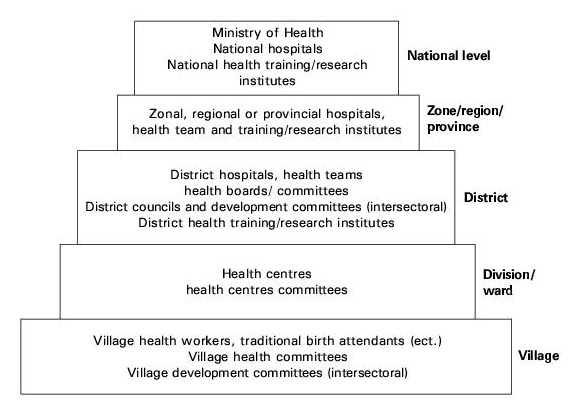
As you know, the health systems comprises both private and public health services. In the public sector, there are many parts in a health system. Each part operates at different level, serving different scope of communities.Smaller systems maybe self contained and limited scale and scope, such as those involved in running a clinic or managing a health information system. Larger systems might involve the coming together of various smaller systems. For instance, the hospitals provide coherence at community or national level. In the district hospitals, there maybe limited equipments and workforce. So, they would refer the patients to the provincial hospital if they are not capable to manage the case due to the setback. For example, after the 1st eruption of Gunung Merapi on 26th of october, those patients with burnt injury below 40% were sent to the nearest hospitals, whereas those with burnt injury more than 40% were directly sent to RS Sardjito.


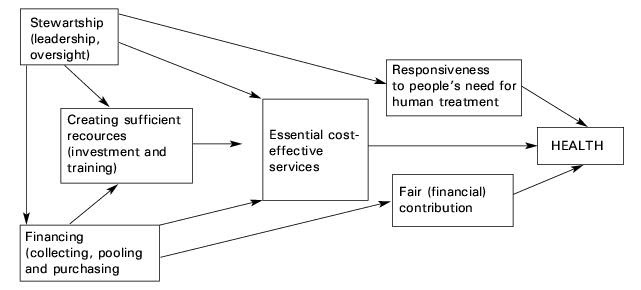
In health system, each object (MOH, health financing bodies, health providers, health services organizations, pharmaceutical companies, communities, etc) interconnect each other, serving for few functions:

1) oversight/stewardship and leadership (policymaking, regulation): This is usally the responsibility of government. It sets the context and policy framework. For those who are playing a role in this part, they may question: what is the institutional framework in which the system and its many actors should function? which activities should be coordinated and how? what are the trends in health priorities and resource generation and their implications for the next 10,20, or 30 years? what information is needed and by whom to ensure effective decision making on health matters, including prevention and mitigation of epidemics? An additional central function is generating appropriate data for policymaking. These range from public health surveillance data to health system performance and provide the basis for accessing health status, regulating the sector and tracking health system perforrmance, effectiveness and impact. reading until here, u may ask: How to access health status? Health status can be measured by measuring the morbidity and mortality rates (eg. maternal mortality rate, infant mortality rate), life expectancy,etc. Therefore, a good stewardship and leadership will:
  • ensure that health authorities take responsibility for steering the entire health sector and dealing with future challenges as well as with the current problems.
  • Set direction by defining national health policies, strategy and plan, so that high policy goals will be achieved (such as health equity, people centeredness, sound public health policy, effective and accountable governance). By such, the goals can be translated into its implication for financing, human resources, pharmaceuticals, technology, infrastructure and service delivery (including cost-effective services).
  • have an effective regulation, backed up by legal measures and enforcement mechanisms
  • effective policy dialogue with other sectors
2) health service provision (e.g., clinical services, health promotion): WHO 2000 described delivering health services as an essential part of what the system does. but it is not what the system is. It may because of the health systems are only as effective as the services they provide. According to WHO 2010, service delivery depend on:
  • networks of close-to-client primary care, organized as health districts or local area networks, with the back up of specialized and hospital services, responsible for defined populations.
  • provision of benefits with comprehensive and integrated interventions, that respond to full range of health problems of their populations
  • standards, norms and guidance to ensure access and essential dimensions of quality (safety, effectiveness, integration. continuity, people centeredness)
  • mechanisms to hold providers accountable for access and quality and to ensure consumer voice.
3) financing: its main objective is to facilitate universal coverage by removing financial barriers to access and preventing financial hardship and catastrophic expenditure. What can facilitate these outcomes? 1) raise sufficient funds; 2) A system to pool financial resources across population groups to share financial risks; 3) A financing governance system supported by relevant legislation, financial outdit and public expenditure reviews and clear operational rules.There are few revenue collection mechanisms: 1) general taxation; 2) developmental assistance for health (DAH, donor financing); 3) mandatory payroll contributions; 4) mandatory or voluntary risk-rated contributions (premiums); 5) Direct household out-of-pocket expenditures; 6) other forms of personal savings. In most countries, health financing is a mixture of tax, premiums and out-of-pocket. For the poor, finance is the factor which deter them from seeking health care when sick or injured. To protect the poor and to increase the health status of the poor, effective risk pooling is essential. In this context, risk pooling refers to the collection and management of financial resources in a way that spreads financial risks from an individual to all pool members. This is usually the core function of health insurance mechanisms.

4) managing resources: In the previous post, i have described the input of fish pond system by using 5M. Similarly, 5M (man, money, materials, method, machine) is applied in health system to describe the input/resources. 
  • Man? This implies the human resources. How to manage the human resources? By: 1) arrangement to achieve sufficient of right mix (numbers, diversity, and competencies); 2) payment systems to provide the right kind of incentives; 3) regulatory mechanisms to ensure system wide deployment and distribution in accordance with needs; 4) establishment of job related norms, deployment of support systems and enabling work environments; 5) meachanisms to ensure cooperation of all stakeholders (health worker advisory groups, donor coordination groups, private sector, professional associations, communities, client/consumer groups)
  • Money? as what i have discussed before this.
  • Materials? "Materials" refer to medical products and information. 1) Medical products should be regulated for marketing authorization and safety monitoring, by setting relevant legislation and enforcement mechanisms. Besides that, there should be national lists of essential medical products, national diagnostic and treatment protocols, and standardized equipment per levels of care, to guide procurement, reimbursement and training. A supply and distribution system is established to ensure universal access to essential medical products. Also, a national medical products availability and price monitoring system are established as well as the national programme on promoting rational prescribing. 2) Health information on a) the progress in meeting health challenges and social objectives (by doing household surveys, epidemiology surveillance); b) health finance (by doing financial analysis); c)pharmarceuticals; d) appropriateness and cost of technology; e) distribution and adequacy of infrastructure; f) access to care and on the quality of services provided.
  • Method? it implies the method of regulating the whole system (how to regulate the system, how to manage the finance, how to access health status, how to improve the quality of service, how to access the quality of health service, etc). They are managed by the legislation and policies.
  • Machine? It refers to the technology, the equipment used for telecommunicating, diagnosis, treatment, etc.  Health information about the appropriateness and cost of technology are obtained and then further analyzed. Besides that, a system is created to ensure universal access to essential health technologies.
What factors influence the health system?


This figure would take different shapes in different societies, but everywhere individuals form part of a network of family and community members who are concerned about their health. This network prescribes or advises how to prevent illness and what to do in case of ill health. In many societies, mothers and grand mothers are key figures in early childcare. They determine nutritional and hygiene practices, alert children to dangers, provide care in case of disease, and teach children the basics of self-care.
At the other end of the spectrum, a public authority is responsible for the well being of all people inhabiting its territory. Nowadays governments of states organise public health care and, to some extent, regulate private health care initiatives. Through other social services (e.g., education, social welfare), through laws and taxes and police and army, governments are supposed to assure their citizens the resources to survive and live in peace. Since time immemorial this has been the duty of rulers, although each society has developed its own ways of ensuring ‘health for all’.

Reference:
1) http://siteresources.worldbank.org/HEALTHNUTRITIONANDPOPULATION/Resources/281627-1154048816360/AnnexLHNPStrategyWhatisaHealthSystemApril242007.pdf
2) WHO 2010. Key Components of A Well Functioning Health System.
3) Corlien M. Varkevisser, Indra Pathmanathan, Ann Brownlee; Designing And Conducting Health System Research Projects, Volume 1: Proposal Development and Fieldwork; KIT Publishers and the International Development Research Centre (IDRC), in association with the Africa Regional Office (AFRO) of the World Health Organization; 2003.
4) http://regional.kompas.com/read/2010/10/26/20523040/RS.Sardjito.Terima.Korban.Luka.Bakar
5) Prof. Dr. Laksono; Lecture Block 4.2: Introduction of Block 4.2 And Health System And Its Outcome.

Sunday, November 14, 2010

System thinking and its application to the daily life

on the 1st day of this block, I asked myself: health system? why do we need to learn about this?? It is such a boring topic! =(

One day before the practical session "system thinking*, when i read the manual book about systemic thinking, I asked myself and my closed friend: what should we learn from this practical session? what are the objectives? I can't see the point at all...

Day by day, you may find out the interesting part of it, just like me. From the practical session "system thinking", i have learnt something. We can apply the system thinking to the real life.

My mind: The lecturers teach us about health system. In the manual book, it is stated that system consist of objects, attributes, internal relationships among its objects, and systems exist in an environment. Feedback is essential. Besides that, in the theory, it is stated that a system can be understood as an arrangement of parts and their connections that come together for a purpose. 

hmm..let's think about the system in the international programme in medical faculty of UGM. There are few questions in my mind:

What is the purpose that this system serves? To produce sufficient numbers of skilled medical doctors with technical competencies? if so, are our welfare concerned by the authorities? If yes, why did the executives in this system insist to resume the academic activities on 15th of Nov although they knew that the Malaysians (for your information, in batch 2007,around 85% are Malaysians) could not go back to Jogja before 17th of Nov due to the problems related to the ERP? yeah, the Malaysians are allowed to go back before 22nd of Nov, but don't they know that some of the students do not wish to miss the class? why can't they be more considerate? if everything can be learnt through Gamel, does it mean that every student can skip all the classes? cause after all, it implies that there is no difference between learning in the class and self-learning at home! i don't understand...seriously don't understand why the class cannot be started on 18th or 22nd of Nov,so that every student can attend the classes...are the students' welfare concerned? Is the EQUITY met within this system? are we, the students, the objects of this system? Is this a good system? is there sufficient communication between students and the executives?or....am i alone having some misunderstanding over the issue? :(

Reference:
1) Manual book of Block 4.2.

Monday, November 8, 2010

Fish Pond system? It can be related to health system?

"Grp 5, you need to observe the fish pond and figure out the fish pond system," said Prof. Dr. Laksono.

"What?Fish pond system?" I exclaimed. I then realised that friends around me were staring at me. Believe me, i didn't mean to exclaim. I was too shocked!

How could fish pond system related to health system? I wonder. It sounded ridiculous...yeah..for me...

So, what is a fish pond system?

              Let us have a bigger picture. We should not only think about the fish in the pond. If you have a narrow picture only, you will learn nothing from the fish pond system. Besides the fish, what are involved? What are the resources? Who is responsible to manage the resources? Who is responsible in the stewardship and governance?


*jing jing* this is the diagram! you may ask: why Dean? why financial department? before i draw this diagram, my groupmates asked me the same question. funny huh? not at all. For me, they play an important role. I find no reasons to cancel these two components from the fish pond system. Let me explain this.

               The fish pond system is started with the Dean, who plays a role as a leader of the whole system, taking in charge of the whole system in the medical faculty of UGM. The financial department is under Dean. This department is responsible in deciding how much money to be allocated  to the environmental department after the executives in financial department have had a meeting with the Dean and also the executives from the environmental department. Dean, together with the executives in financial and environmental department, they play a role in the governance and stewardship. They set the context and framework for the whole fish pond system. How should the fish pond system function? how to access the health and growth of the fish?These questions are the core of the stewardship function. For the environmental department, there are staffs who are responsible in taking care of the fish pond. So these pond keepers will directly deal with the fish pond system. In the fish pond system, there will be a subsystem, which is water circulation system. This water circulation system consists of electricity, water pump, water and pipes. The electricity runs the water pump. So this water pump will pump the water from the underground and then the water will be drained into the fish pond through the pipes. When there is a system within a system, u call this as a complex system. Each component of the system is interrelated to other component and they influence each other.

                Therefore the input of the fish pond system will be the 5M:
1) Man (executives of the management and the pond keepers);
2) Money (from the financial department);
3) Material ( the food for the fish, water, fish, plants, stones, etc);
4) Method (how the pond keepers take care of the fish ponds, method of the governing the whole system);
5) Machine (the water pump).
                The input can also be classified into 2 categories:
1) Essential. For the essential inputs, they will be the water, oxygen, fish, algae, electricity, water pump, drainage, food of the fish, sunlight, plants in the pond, money, and pond keeper.
2) Accessory. The accessory inputs are stones, the light/lamp posts, the place for standing near the pond and trees.
                 The process of the fish pond system is cleaning the ponds, draining the water out from the pond, feeding the fish, managing and maintaining the fish pond system and making sure the electricity is always available. The output is the fish health and growth. This output influences the input. It exerts a feedback in the fish pond system. So, if the output is not ideal at all, the 5M will be modified in order to get a good outcome.


How is it applied to health system?
               From the fish pond system, u can get some idea of what a complex system is, components in a system, the input, process and output, and how the output affects the input.
                Health system is comprised of Ministries of Health, health providers, health services organizations, pharmaceutical companies, health financing bodies, and other organizations and communities. 
                The Dean in the fish pond system plays a similar role as the Head of Ministry of health, whereas the environmental department is similar to a system in a hospital, primary health care or clinic. The pond keepers are the physicians, meanwhile the fish are playing a similar role as the communities in the health system. If the health system is simplified, so this is the picture:
Of course, this is really a simplified one. This is a rough idea of what a health system is, so that u can easily understand it. I will discuss more about health system (including factors which influence the whole system) in another post. So, make sure u cont' reading my blog. cya ;) 

Reference:
1.http://siteresources.worldbank.org/HEALTHNUTRITIONANDPOPULATION/Resources/281627-1154048816360/AnnexLHNPStrategyWhatisaHealthSystemApril242007.pdf
2. Dr. Andreasta Meliala. Lecture: Human Resource Management In Health Care Setting
3. Practical Manual Book Block 4.2
4. WHO. Key Components of A Well Functioning Health System. May 2010.

Wednesday, November 3, 2010

Preface

I am creating this for my block 4.2- Health System and Disaster because I have chosen blog as my contract. To all my readers, please read all my entries with an open-minded manner and feel free to leave a comment. We should learn this topic together. There are too much to be learnt in this topic.

According to Prof. Dr. Laksono, whatever we write should always be some theories and facts. But I actually disagree with his point. When we are blogging, we are not always writing facts and theories. We can also write our feelings, comments and opinions about this block.  Feelings, opinions, comments are something subjective. Sometimes, they cannot be supported by facts and theories from a book.

To support my stand, therefore, I would like to define "Blog". "Blog" can be defined as: 1) A blog (a blend of the term web log) is a type of website or part of a website. Blogs are usually maintained by an individual with regular entries of commentary, descriptions of events, or other material such as graphics or video (wikipedia); 2) a shared on-line journal where people can post diary entries about their personal experiences and hobbies; "postings on a blog are usually in chronological order" (the free online dictionary).

Therefore, in my blog, there would be facts, theories, my thoughts (including some questions in my mind), my feelings and maybe some comments (positive or negative) which are related to this block. Hopefully, by that, we would understand this topic well and if there are questions in my mind, you can help me to solve my puzzle.

Thank you.