Thursday, December 2, 2010

The dead

"A volcano eruption has just happened. A lot of people are dead. We need your help!"

When death is involved in a disaster, we need to identify the dead victims. Why? it is a respect of death person, and it is for the purpose of legal claims and obligation in relation to property, estate and debts.

So, who are in the disaster victim identification (DVI) team?

1) the police or interpol (international police)
2) forensic pathologist, anthropologist and dentist
3) army
4) trained volunteers

There are few procedures in DVI:

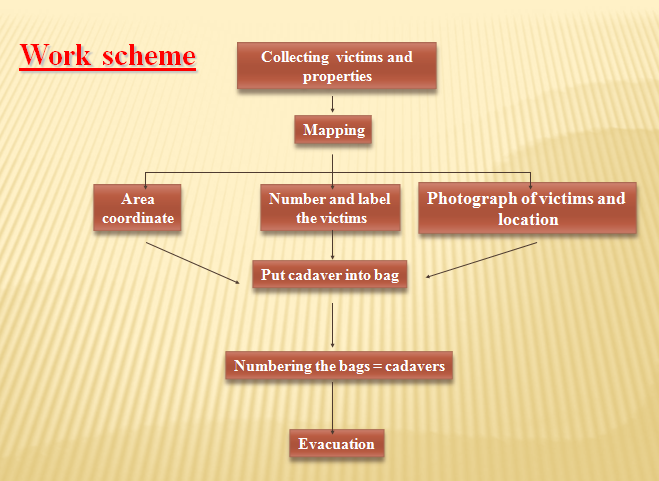
1) Phase I: Scene. The team will search for bodies, body parts, properties, mapping the area of disaster, labelling, documentation, putting the dead bodies in body bags.

2) Phase II: Mortuary: Post-morten examination. They will do:

a) Documentation: bodies, body parts, properties.
b) External-internal examination, autopsy: forensic pathologist's job.
c) Identification of race, sex, age, stature: Forensic antropologist's job.
d) Dental examination: Forensic dentist and anthropologist's job.
e) Record body fragmentations: What body parts are missing.
f) Taking samples for DNA examination: blood, tissue, bone, teeth.
g) Taking roentgen of the upper and lower jaw with teeth.

All post-mortem examination data is recorded in pink form.

3) Phase III: Antemortem data compilation. The data is gathered from family members, friends, doctor, dentist (medical record for matching with the primary identification traits). The data can be vital signs, specific characters, jewelery, watch, clothes (for matching with secondary identification traits). All the antemortem data is recorded in yellow form.

4) Phase IV: Reconciliation. It is to compare antemortem data with postmortem data. Identification is confirmed when there is one primary identification method is matched (DNA, fingerprints, dental profile) or at least 2 secondary identification method are matched ( visual, photography, properties, medic-anthropology).When all parties provide evidence and proofs that matched/identified-->signed and dated.

5) Phase V: Release and debrief.
  • Release. The dead body is released to the family member, along with the letter.
  • Debrief: Compile documents. DVI team is dismissed.


How if the dead body is unidentified?
According to Dr. Yudha Nurhantari, a victim is defined as "unidentified" when it is more than 48 hrs in the morgue. Usually during the period, the information or the photographs of the dead body is released to the media. According to Prof. Drg. Etty Indriati, in a disaster settings, if the dead body is unidentified after 3 days, mass burial will be done. They will be buried 2m in depth.


In DVI,

they say: The success indicator is not the the speed, but the accuracy

Reference:
1) Dr, Yudha Nurhantari. Lecture: Management of Dead Victims In Mass Disaster.
2) Prof. Drg. Etty Indriati. Lecture: The Roles of Anthropology in Disaster Victim Identification.

Wednesday, December 1, 2010

What is disaster?

What is DISASTER?


Disaster is defined as sudden ecological phenomenon of sufficient magnitude to require external aids. It is also defined as an event or a series of events that are caused by natural factor or man-made factor, resulting in loss of human lives, environmental damage, loss of properties, and psychological problem. Consequently, human lives are harmed and disturbed.

Let's look at the conceptual framework of a disaster:


1) Hazard: Hazard is the cause of an event or a disaster. For example: the hazard of flood is the rain; the hazard of volcanic eruption is the volcano.

2) Risk: A factor which increases the probability of a hazard to become an event. For example: Deforestation will increase the probability of a flood to take place;

3) Event: It is caused by the hazard. For example: flood, volcano eruption.

4) Impact: When the event involves a population, but not yet a disaster. For example: There are 10 victims are injured in the volcanic eruption. However, the situation is handled well by the local authorities. So, there is no external aid requested.

5) Damage. For example: building collapse, loss of human lives.

6) Change of social function: Cannot do daily life activities. For example: cannot go to school.

7) Disaster: A situation where external aids are needed in order to recover the whole situation back to normal. For example: Reconstruction of all this needs a large number of resources, funds included, which cannot be accomplished by local people and government. They need help.

How do we manage a disaster?


1) Prevention: It is defined by Dr. Hendro Wartatmo as a step to eradicate the hazard. Hence, prevention can only be done for man-made disaster, but not natural disaster.

2) Mitigation: It is an effort to reduce the risk as well as the impact of an event and the vulnerability of objects or individuals. For example: build earthquake-proof houses.

3) Preparedness: It is a step to increase the capacity of objects/ individuals in order to be able to manage the the impact of an event and lessen the damage after an event happens. So, it embraces measures which enable governments, communities and individuals to respond rapidly to disaster situations to cope with them effectively. It includes:

a) Formulate emergency plans. For example, establish hospital incident command system. It provides hospital with tools needed to advance their emergency preparedness and response capability. It allows personnel from different agencies or departments to be integrated into a common structure that can effectively address issues and delegate responsibilities. Besides that, it provides needed logistical and administrative support to operational personnel.

Further reading of HICS: http://www.scha.org/images/stories/quality/hics_monograph.pdf

b) Development of warning systems

c) The maintenance of inventories

d) The training of personnel. For example: train medical students for basic life support; train the personnel for psychological first aids: active listening, empathy, access the basic needs, don't force the victims to speak, avoid secondary stressors; train them to be able to identify people with depression, post-traumatic stress disorder or other psychological disorders.

4) Resilience: It consists of absorbing capacity, buffering capacity and response.

a) Absorbing capacity: According to Dr. Sulanto Saleh-danu R.,it can done to reduce the damage or prevent the event from causing damage. For example: build a dam to absorb the lava.

b) Buffering capacity: It is about how we cope with the impact and damage of the event. For example: We need logistic support in this step in order to support the organization and implementation of response, so that we can ensure the timeliness and efficiency. The logistic support can be: medicines, health supplies/kits, water and environmental health, food, logistic administration, shelter, electrical constructions, personal needs and education, human resources, agriculture, transportation and others.


How do we calculate the available resources?
c) Response. It is the activities done immediately after the event happens in order to handle and manage the negative impacts and damage. The activities includes:
  • Rescue and evacuation of casualties. The medical response can be divided into prehospital and hospital. For prehospital stage, they need to do triage, resuscitation, stabilization. No definitive treatment is given. For hospital stage, they need to do the triage again (because the patient's condition may alter during the journey to hospital), resuscitation, stabilization and give definitive treatment.
  • Fulfilment of basic needs.
  • Protection, e.g. place the victims in a safe place.
  • Management of refugee and dead bodies.
  • Recovery of infrastructure and facilities.


5) Recovery, rehabilitation, reconstruction.

a) Recovery: It is the process, policies and procedures for recovery or continuation of technology and infrastructure critical to an organization after a disaster.

b) Rehabilitation: It is about the restoring and recovery of the public services and social functions, so that everything (the community's living and the administrative aspect) can be returned to the norm.

c) Reconstruction: Reconstruct the infrastructure, and institutions in order to restore and develop the economy, social and culture as well as the law and regulation in the region after the disaster.


In conclusion,
we as a doctor, can take part in preparedness, resilience and recovery. If a disaster happens and it is the 1st time in the country, there might be a lot of mistakes done and we might face a lot of shortages: e.g. hosp inable to provide enough medical supports or space to treat the victims, infections spread among the victims, etc. The important thing is WE HAVE TO LEARN FROM MISTAKEs, so that we will know what to do in the next time. That's how we will know what to do for the prevention, mitigation and preparedness.

Reference:
1) Dr. Hendro Wartatmo. Lecture: Conceptual Framework of Disaster and Disaster Management.
2) Dr. Bambang Hastha Yoga. Lecture: Disaster Management in Mental Health.
3) Dr. Belladonna. Lecture: Preparedness, Response and Recovery.
4) Dr. Sulanto Saleh-danu R.. Lecture: Logistic (medical) and Disaster.

Motivation

How do I motivate my assistants or employees to work? This kind of question may always be asked by a leader.

Before answering this question, let's think about this: When will one be motivated to work? and why?

-Monetary gain?
-Self-satisfaction?
-Challenging job?
-Freedom?
-Treated fairly in workplace where there is no bias?

There are few theories explaining what motivation is. Let's read about the scenario below:

"Ann, I don't want to work at here any more.."

"Why? U have found a new job?"

"No, I just find it meaningless for working at this primary health care center. Everyone is doing their own work alone, without helping each other. And..you see, Mary and John are always late, while Carmen is always finding an excuse to go out to serve her private patients. Although they don't do their job well, they still get the same salary, as us. No matter how hard we work, there is no promotion and we don't get higher incentives. It is very unfair for us! I lose my motivation to work!"


Why does the girl want to quit the job? Because she is not treated fairly and the outcome she gets is not proportional to the effort she puts. So, in this scenario, it involves 2 theories: Equity theory and expectancy theory.

1) Equity theory.
It says that motivation will be enhanced if people think they are being treated fairly.

2) Expectancy theory.
It explains that motivation is a function of 3 distinct concepts:

a) Expectancy. It is based on the perceived effort-performance relationship. It is the expectancy that one's effort will lead to the desired performance and is based on past experience, self-confidence, and the perceived difficulty of the performance goal. For instance: If I work harder than others, will I produce more?

b) Instrumentality: It is based on the perceived performance-reward relationship. It is the belief that if one does meet performance expectations, he or she will receive a greater reward. For instance: If I produce more than anyone else, will I get a bigger raise or faster promotion?

c) Valence: It refers to value the individual personally places on the rewards. It can be one's needs, goals, values, money, etc. For instance: Do i want a bigger raise? is it worth the extra effort? Do I want a promotion?


In another words, motivation= expectancy x instrumentality x valence. In the scenario above, the worker does not perceive ''instrumentality". As a result, there is no motivation to work.

Are there any other theories? Read the following:

Dr. A is sent to puskesmas X to work. After several days, he finds that the medical record system is poor, and there is no one there to help him out, except 1 nurse. Some of the workers come to work late, but leave the puskesmas earlier than anyone else. When he asks the admin about the data, e.g. the top ten disease in that puskesmas, the time sheet of the workers, the admin can't show him any data about that. There is no teamwork, no management, and no health information. They don't communicate well with each other.

"Doctor, the working condition and the health system in this puskesmas are very poor. Why are you still enthusiastic about doing your job here?"

"Well, Ann, don't you think this is challenging? I am so glad that I finally get a very challenging task. I want to solve the problems here and then improve the health system of this puskesmas, including the management, within 6 months. I believe that I am able to do this".

After reading this scenario, can you answer why Doctor A is motivated to work? Because the job is challenging and he thinks that he is able to do so.

2 theories can be applied in this scenario: Goal theory and self-efficacy theory.

1) Goal theory.
It explains that motivation and performance are higher under 3 conditions: i) specific goals of individual; ii) goals are challenging and difficult to achieve; iii) feedback on performance.

2) Self-efficacy theory.
It explains that people are more likely to be motivated to do a better job if they believe they are able to do so.


In conclusion,
one can be motivated by intrinsic factors (e.g the goals, expectations, self-satisfaction, etc) and extrinsic factors (e.g money, promotion, benefits, etc). With the motivation, they can perform better when they are on duty. However, if one is not capable, and is not given a chance to work, no matter how one is motivated, they still cannot perform in the workplace.

So, train your workers, give them a chance to work, and motivate them! ;)

p/s: there are few more theories mentioned in the lecture note "motivation". So, remember to read it =)

Reference:
1) Dr. Andreasta Meliala. Lecture: Motivation.
2) http://www.12manage.com/methods_vroom_expectancy_theory.html
3)http://www.quickmba.com/mgmt/expectancy-theory/

Tuesday, November 30, 2010

It is declared as pandemic!


"The world is now at the start of the 2009 influenza pandemic," said the WHO director-general Dr. Margaret Chan on 11 June 2009.

So, when is a disease called as pandemic?


Phase 1-3 correlate with preparedness, including capacity development and response planning activities.
Phase 4-6 clearly signal the need for response and mitigation efforts.
Periods after the 1st pandemic wave are elaborated to facilitate post-pandemic recovery activities.

Criteria of each phase:

Phase 1: no viruses circulating among animals have been reported to cause infections in humans.

Phase 2: An animal influenza virus circulating among domesticated or wild animals is known to have caused infection in humans. It is considered as a potential pandemic threat.

Phase 3: There are sporadic cases or small clusters of disease in people, but has not resulted in human-to-human transmission sufficient to sustain community level outbreaks.

Phase 4: Community level outbreaks by human-to-human or human-animal transmission. It indicates a significant increase in the risk of a pandemic. Any country that suspects or has verified such an event should urgently consult with WHO.

Phase 5: Human-to-human spread of the virus into at least two countries in one WHO region. It is a strong signal that a pandemic is imminent. The time to finalize the organization, communication, and implementation of the planned mitigation measures is short.

Phase 6: Pandemic phase, characterized by community level outbreaks in at least one other country in a different WHO region in addition to the criteria defined in phase 5.

Post peak period: Pandemic disease levels in most countries with adequate surveillance will have dropped below peak observed level.

Post pandemic period: Influenza disease activity will have returned to normal level. The pandemic virus is expected to behave as a seasonal influenza A virus.


Our main concern: What is a GP's role in a pandemic preparedness?


First, we have to know what "pandemic preparedness" is. The pandemic preparedness is categorized as:

1) non-pharmaceutical (public health): It is aimed to reduce the social impacts, such as social distancing by prompt case isolation, household quarantine, and closure of school and workplaces. In addition, it includes data collection and surveillance and basic respiratory hygience practices as well.

2) pharmaceutical: It includes vaccination, anti-viral medications, stockpilling of vaccines and drugs and  co-ordinated effort in distribution. This would involve pre-pandemic vaccination and treatment of cases for secondary prevention.

Secondly, what role do we play? (scenario: H1N1 influenza pandemic)

1)  Teacher and psychologist: GPs should educate the patients about what the disease is, and the transmission mode. We must disseminate the information to the community on how to prevent the disease, from whom they can get health service and medication when they are ill, and the reinforcement of personal hygiene as well as the other precautious measures. Then, we have to get the feedback from the community and need to ensure that they can understand what we say and we solve all their puzzles regarding to the H1N1 influenza. Other than that, GP should also provide psycho-social support to the community. Therefore, GP should establish a good relationship with the community by having a great communication with them.

2) Detective, gate keeper, coordinator and reporter: The GPs are the gatekeepers. We play the frontier role in management of patients with influenza without complications to allow unexpectedly large numbers of ill patients to be managed in the community. So, we should be able to detect the epidemics and mini epidemics of viral illness in accordance to national guidelines to avoid missing cases. We can coordinate triage system for suspected cases. Then, we identify the vulnerable and at risk groups for necessary health protection. Specimens will be collected from the suspected cases for rapid diagnosis. Besides that, we have to coordinate the care for the close contacts or the family members of the suspected targets. If we have detected the patients with H1N1 influenza (cluster of people or large group of community with same sign and symptoms and tested H1N1 positive) we should report to the district health officer. The epidemiological data obtained in primary care represents the best proxy measurements of the day-by-day prevalence of ailments in the community. Since we play a role as detector and gatekeeper, self-protection is essential, so that we will not be infected with the virus.

3) Pharmaceutical measure: It includes the provision of vaccines, esp during the pre-pandemic period, anti-viral drugs, etc.


4) Monitoring and assessment: We have to monitor the suspected targets as well as their close contacts. We then assess their condition. For the follow up, it is preferred to implement home-visit-approach or setting a special review clinic to avoid cross infection. Moreover, we are responsible to monitor the resources in primary health care to ensure that we always have enough supply for our demands. We also need to assess the capacity to manage large number of ill patients.

5) Have a great communication with public health authorities: To get the epidemiological update and results of investigations, so that we can provide better, comprehensive and continuing care in this pandemic setting. Therefore, there will be no misdiagnosis and unnecessary referral to secondary care.

Wow, a lot of roles, right? Yea, being a doctor isn't an easy job, esp. when there is an outbreak of disease or a disaster happens.... This is absolutely a challenging job! ;)

Reference:
1) http://www.who.int/mediacentre/news/statements/2009/h1n1_pandemic_phase6_20090611/en/index.html
2) http://www.medicinenet.com/script/main/art.asp?articlekey=101133
3) http://www.who.int/csr/disease/swineflu/phase/en/index.html
4) http://www.biomedcentral.com/1471-2458/10/661

Monday, November 29, 2010

Surveillance? @.@ I know nothing about it!

Scenario:

"The number of HIV cases is increasing from 1990-2008 in Indonesia, while in other countries like Thailand, Myanmar and India, the HIV prevalence has declined. So what should we do now in order to reduce the number of HIV cases in Indonesia?? We do not know who are at higher risk and the major mode of transmission!"

"I think what we should do now is to conduct a surveillance".

After reading the scenario, you may ask: Surveillance? hmmm...sounds familiar but I don't know what it means...So, what on earth is it?Why do we need to do a surveillance?

Yea, I'm sure you have come across with the word "surveillance" in my previous blog. Surveillance is defined as the ongoing, systemic collection, analysis and interpretation of health-related data (e.g. regarding agent/hazard, risk factor, exposure, health event) essential to the planning, implementation and evaluation of public health action to reduce morbidity and mortality, and improve health status. It can also serve as an early warning system for impending public health emergencies. Besides that, documentation of the impact of an intervention can be done through surveillance. It can also be used to monitor and clarify the epidemiology of health problems, to allow priorities to be set and to inform public health policy and strategies. By doing the surveillance, it can prevent and control a disease, especially if it is a sudden outbreak.

How do we get the data when we are doing surveillance?

There are a lot of sources, such as:
  • mortality reports
  • morbidity reports
  • reports of individual case investigation
  • reports of laboratory utilization (including laboratory test results)
  • special surveys (e.g. hospital admissions, disease registers, and serologic surveys)
  • information on animal reservoirs and vectors
  • demographic data
  • environmental data
After collecting data, what should we do next?


(cont' of the scenario given above) "So, what is the result of the surveillance? How do we apply it?"

Let's look at the chart below:


The chart above is drawn after the collection and compilation data. This is the analysis. From the chart above, (interpretation of data) we can see that unsafe sex and injecting drug use are two major mode of transmission. In other words, those who are having unsafe sex and using injecting drugs have relatively higher risks to get infected with HIV, compared to normal people. We also know that HIV can be transmitted to other people through blood and mother-to-child transmission, although the risks are relatively lower than that of unsafe sex and injecting drug use. After that, we should disseminate the data to the public. Therefore, by using this surveillance data, we can raise the awareness of all parties and also take few actions (utilization of surveillance data), e,g. set health policy and strategies in reducing the numbers of injecting drug users, promoting use of condom, set our target population and give them education, promote the program of VCT(voluntary counselling and testing), PMTCT (prevention mother to child transmission), PTRM(program terapi rumatan methadone), etc. Through these, HIV cases can be reduced and the health status of the community, hence, will be improved.

So, from the scenario I created, do you have a clearer picture of what surveillance is, the steps of how to do it, how we utilize the information that we get from a surveillance and the purpose of doing it? Hope it helps =)

Reference:
1. Dr. Luthfan Lazuardi. Lecture: Surveillance, Response, and The Role of Public Health Informatics
2. http://www.who.int/topics/public_health_surveillance/en/
3. http://www.cdc.gov/ncphi/disss/nndss/phs/overview.htm
4. http://www.searo.who.int/LinkFiles/Publications_HIV_AIDS_Report2009.pdf

Sunday, November 28, 2010

STOP spreading the HIV!

HIV/AIDS disaster?
It is defined as continous increment of the number of HIV+/AIDS cases in a certain population/region/country after implementation of nation-wide programme in a certain periods of time.

Let's have a look of the data regarding to HIV/AIDS:

HIV cases in Asia

NO. OF NEW HIV INFECTIONS, AIDS CASES AND AIDS DEATHS BY GENDER PER YEAR REPORTED IN MALAYSIA
(From 1986 until December 2008)

HIV cases in Indonesia from 1987 to 2008
When you look at the data of HIV population, will you be as shocked as me? shocked bcoz the prevalence and the incidence of HIV and AIDS-related death are increasing with years.

Supposedly, the rate will be dropped as time goes by bcoz there should be increasing number of humans with higher education level compared to 1990 or years before. don't you agree with this point? government from other countries has been giving the citizens free education frm primary to secondary school, so that more people are educated. with higher education level. People should realise the danger of going for prostitution, the danger of having unsafe sex, how to protect themselves by using condom when having sexual intercourse with sex workers or strangers...etc... but how on earth the prevalence and incidence are still increasing? oh, am i too naive? the reality isn't the same as what i think....

Why would this happen? What do you think?
lets see the possibilities of causing this phenomenon:

1) increasing number of adolescents having sexual intercourse at earlier age?
2) increasing number of rich and horny guys who go for the prostitution, but not using condom bcoz they wana get higher pleasure when having sex?
3) more people having relationships with multipartners and have sex with anyone, including a stranger?
4) more people using narcotic drugs? sharing needles?
5) more girls wana make easy money by providing service to the men? they are willing to lose their self-esteem and dignity and pride?
6) increasing numbers of homosexual or heterosexual? esp the gays who do not use condoms when doing anal sex (i.e MSM)?
7) failure to promote or socialize the HIV prevention programme?
8) failure to treat?
9) failure to support or run the HIV/AIDS and STI prevention programme?
10) a problem of decentralization in Indonesia? The responsibilty of collecting data is devolved to the district level due to decentralization process. So now, there is limited human resources and competing claims on resources sometimes undermine activities such as data-collection, which are seen as NON-ESSENTIAL. A failure to maintain standards and quality in public-health-information systems.


What are the prevention efforts?

1) health promotion
2) strengthen health care system
3) multi departmental program

 
Note: HAART=highly active antiretroviral therapy; PEP=post-exposure prophylaxis; PrEP=pre-exposure prophylaxis; STI=sexually transmitted infection; Bolded items are those that use antiretroviral agents.
 Why is STI concerned in HIV prevention?
STI patients have a 2-9 times greater risk of being infected with HIV than people who do not have STI. Therefore, effort to test for and treat STI should be put in.

Why can circumcision decrease host susceptibility to HIV infection?
Because after circumcision the glans penis will develop a stronger layer of squamous epithelium.

How to promote condom usage?
It should be done by:
1) free distribution of condoms to sex establishments at the initial stage, and condom social marketing at later stages;
2) encourage the sex workers to consistently have clients use condoms during sexual intercourse.

BUT, how if the clients and sexual workers insist not to use condom?
1) According Prof. Dr. Siswanto, there is an approach of encouraging the sexual worker to help the clients to wear the condom by using a more interesting tactic, so that the clients will not reject to use condom.
2) Enforce the law: Penalties against any sex establishments that do not consistently use condoms.

Besides that, we should attract the attention of executor and senators,by presenting the cases(including showing them the prevalence of HIV infection) to them so that they will give response upon this issue. A sentinel surveillance should be conducted to monitor STD (sexually transmitted disease) and HIV and condom-use compliance.

Harm reduction among the IDU (injecting drug user): PTRM?
Perhaps you ever hear about VCT (voluntary counselling and testing), PMTCT (prevention mother to child transmission). How about PTRM? Here i would like to explain PTRM briefly.

PTRM (Program Terapi Rumatan Methadone) is a therapeutic programme for the IDU (injecting drug user) to substitute the narcotic drugs with methadone. By using this approach, they expect that there will be decrease of numbers of IDU, hence reducing HIV transmission caused by drug injection.

Who are responsible in preventing HIV transmission?
HIV/AIDS prevention is a national issue. It needs to be tackled through a national response. Hence, efforts should be implemented by the community, the government, and NGOs on a partnership basis. The community, together with NGOs (non-government organization), should be the leading agents while the government takes responsibility for steering, guiding and creating a conductive atmosphere to support HIV/AIDS prevention.

In conclusion,
HIV prevention is focused on:

A: Abstinence
B: Be loyal
C: Condom use
D: No drugs


We, as the doctors, besides taking part in health promotion, and prevention, we should identify those with risks of getting HIV infection, and help the HIV patients to get treatment. There should not be any discrimination to the HIV patients.

HIV/AIDS should not be treated as a stigma in the community. All of us shall participate in this programme and work hand in hand.


 Reference:
1) Dr. Sunardi Radiono. Lecture: HIV/AIDS Disaster and HIV/AIDS in Nature Disaster.
2) Dr. Yanri Wijayanti Subronto. Lecture block 3.6: Screening HIV.
3) Lecture block 3.6: Disease Related to Unsafe Sex and Injecting Drug Use.
4) http://www.ptfmalaysia.org/statistic.htm
5) http://data.unaids.org/publications/irc-pub06/jc978-indonesia_en.pdf
6)http://www.healthpolicyinitiative.com/Publications/Documents/1345_1_Indonesia_HIV_Audit_FINAL.pdf
7)http://www.satuportal.net/content/sebanyak-11-puskesmas-di-jakarta-dilengkapi-prtm-online
8) http://www.thejakartapost.com/news/2010/11/27/national-aids-commission-upbeat-reaching-targets.html

Friday, November 26, 2010

MONEY! How is the payment mechanism for the health care provider?

"When you become a doctor, you can be very rich!" This kind of statements have been made, regarding to our profession.

In fact, is every doctor rich? or it depends on the field you specialize in? or depends on what country you are working in? where there are different payment mechanism in different country. Look at the following table and diagram.
 
Internist, Surgeon and Ob-gy get highest payment in these 8 provinces.
 
Different country, different payment mechanism

Why is provider payment mechanism concerned?

Different payment mechanism will affect a doctor's performance and behavior. A doctor may:

a) provide as many treatments as possible
b) attract as many patients as possible (e.g. by prescribing many drugs, even placebos)
c) sending patients with financially unattractive or hazardous conditions to other providers, such as hospitals
d) asking patients to come back several times even when it is not necessary
e) unnecessarily using expensive equipment they have purchased (e.g. X-ray equipment) in orfer to amortize its cost.

Therefore, a good payment system must be established in order to prevent the kinds of waste and unnecessary services provision described above. besides that, it can prevent brain-drain. A good payment system can also motivate the physicians to perform well during medical practices if they get a reasonable income.

So, what kind of payment mechanism are there?
Type of payment mechanism
 Here, I would like to focus on few payment mechanisms only:

1) Fee for service. It is the fee for specific services and prices per item for drugs or appliances. It is the most common method of payment and the most market-like. For example, a physician gets paid for a consultation or an examination; a pharmacist gets paid for a pack of drugs.

 Problem of this mechanism? These fees or prices may be uncontrolled, meaning that each health service provider can charge as much as the market will pay, so it is difficult to have proper budget. The provider may: a) increase the number of acts (services), resulting in under referral and tendencies for supplier induced demand; b) reducing the quality of the services; c) delegating more acts to lower-paid personnels (eg nurses).

Solution? To solve this, devise a fee or price schedule, setting the upper and lower limit on the prices that may be charged. For instance, In German, physicians are not allowed to charge fees higher or lower than the schedule fees. Another solution is to fix tariffs if there is no compulsory fee schedule. It is important to specify the fees that the health fund is prepared to pay because it is either the health insurance company need to pay for the charges or the patient themselves.  Do utilization review.

How to calculate the fees for specific acts? by using the following: a) the factors used (eg. labour, capital costs, materials); b) the number of units of each factor used; c) the price of one unit

 Benefit? if there is competition among the providers, the quality of service can be maintained at a standard level because patient will not come to the clinic if the quality is not good.


2) Capitation fee. It covers services for one health fund member over a certain period (normally one year). The fee is paid to a nominated provider who has the responsibility to provide health care, without discrimination, for the duration of the cover period. The capitation fee is based on the pooling of risk by the provider. So, if the insured person doesn't use the health service at all during the period covered, the provider will get the profit from there.This payment mechanism is suitable for primary care providers and hospitals. The capitation fees would cover any or all services required at primary and secondary levels. In this context, the GP act as a gatekeeper, acting as a rationing device for utilization of secondary care services. This mechanism is not suitable for the specialists working alone (should apply case payment or even fee-for-service).and pharmacies.

Calculation? It consists of 2 parts: 1) the fee itself; 2) a register of providers (physicians and hospitals) and patients who have registered with each. The patient must declare to health fund which physician or hospital he/she has chosen, so that the provider can be paid. The fee is calculated by dividing the estimated cost of physician's labour, material, capital expenditures and staff by the estimated number of patients per provider.

Benefit? cost containment. Besides that, it encourages the insured person to use one physician on an ongoing basis as they can only register with one physician and hospital. In this way, the medical history of the patient will be known and hence, minor illnesses and chronic diseases can be managed effectively and efficiently.

Problem? It can reduce incentives to provide good quality service. If a provider is guaranteed a payment for each person on his/her register, there may be no motivation to provide high quality care. Therefore, doctor's attention is low and consequently, patient satisfaction is low. Underutilization may happen (supplier reduce demand). There may be excessive referral. 

Solution? The patient is allowed to change providers after a certain period (usually one year) in order to maintain competition among providers. Moreover, we can establish and apply clear standards for the provider. If the providers do not meet the standards, health fund can withdraw them from the list of providers.

3) Salary. It is normally based on a labour contract between the provider and the health fund. The provider is paid monthly The amount of paid is the same, regardless of the number of the patients to be treated. Equipments, materials, and additional staff are paid by health fund.

Problem? Emploted staff may have fewer incentives to perform well and maintain high standards than independent staff. However, the employee's motivation depends to a greater extent on the quality of management (amount of salaries, promotion prospects, the organization and responsibilities of individual units, the scope for decision making, etc). Bureaucracy, formalism, inflexibility and lack of motivation are the problems. The admistraion costs are likely to be higher.It is hard to guarantee the same performance of the providers (quantity and quality of work).

Benefit? Planning and budgeting is easier.

Comparison of performance of different payment mechanism
What are prospective and retrospective payment systems?

a) Prospective: capitation, salary
b) Retrospective: fee-for-service

Can these mechanisms be applied together?

Yes. As an example: a capitation fee as the basic payment; fees for service for certain acts (immunization, night calls); a flat rate for approved investments (eg. physicians receive a fixed budget to buy equipments); a budget for drugs and ancillary services


Reference:
1. Charles Normand and Axel Weber. Social Health Insurance: A Guidebook for Planning. WHO and International Labour Office.1997.
2. Prof Dr. Laksono. Lecture: Provider Payment Mechanisms.
3. Prof.Dr. Laksono. Lecture: Introduction of Block 4.2 and Health System and Its Outcome.